I've decided to make this post about a smattering of different subjects, some old and some new, some fun and some serious. Enjoy!
Pepero Day!
Pepero Day!

November 11 (11/11!) was Pepero Day, sort of like Korea’s Valentine’s Day in addition to the usual one in February. But instead of giving chocolates and flowers to your crush, on Pepero Day you give peperos! They’re like cracker sticks covered with chocolate or other fancy, sweet toppings. It’s basically a holiday created by the company Lotte, a department store brand you see everywhere here. Let’s just say that us teachers ended up with a lot of sugar in our systems that week, courtesy of our students. I went to the supermarket the day before and it was crammed with boxes of peperos stacked to the ceiling and people doing their last-minute pepero shopping.
Children’s and Teachers' Days
 |
| This says "I love you Teacher" |
Children’s Day on May 5th was another famous holiday in Korea. It’s a vacation day where kids get presents from their parents and can spend the day doing things that children like. Within the next two weeks are Parents’ Day and my favorite, Teachers’ Day! I received several little gifts from my students, like a Starbucks travel mug, some fancy tea, and a few handmade crafts. I didn’t get as much as the Korean teachers who talk to the kids' parents every day, but it was still very much appreciated.
"1600 Pandas+"
On June 21st I witnessed the awesome and very random exhibit "1600 Pandas+", which has been traveling around Korea and the world to raise awareness of the 1600 giant pandas remaining in the wild when the project was started in 2008. (The "+" represents the increase in the panda population since then.) The project is a joint effort by the World Wildlife Fund and French artist Paulo Grangeon. All of the pandas were handmade from recycled paper mâché and were in town for only 5 hours before moving on to the next city. I'm glad I caught it while it was here!


Weird Korean Transportation
 I went back to the ARC the other day and was shocked to find the biking path filled with things other than traditional bikes. Of course there were the bikes with small wheels like I've mentioned before, and this time I also saw bikes with normal-sized front tires and mini back tires, like a less extreme version of those from the late 1800s. But most noticeable were the brand-new Segways crowding up the lane and holding up biking traffic. Then there were electric scooters, both standing and sitting. And a couple of people had these futuristic new things called "Airwheels" that seem to be getting more popular with the hip crowd nowadays (are they in the States too?). I saw one of these wheels being sold for around $700, which isn't cheap. For the first time I also saw a kind of double Airwheel, like a skateboard with two huge, motorized wheels controlled by a remote attached to a wire. I wasn't exactly appreciative of how all this smelly technology was interfering with the biking path and the serenity of the nature around it. What happened to good old fashioned exercise in the great outdoors?
 |
| Couple bikes! |


My First Korean Wedding
 This June, I was honored to attend my Korean head teacher's wedding. First off, while there were some elements in common with Western weddings, like the priest presiding over the ceremony (this happened to be a Christian wedding) and the bride’s white dress, there were definitely some differences, too. The whole ceremony lasted 30 minutes and was conducted in a "wedding hall" where there were weddings going on simultaneously on the other four floors. These wedding halls are almost like marriage factories, where each party reserves a two-hour slot and then quickly empties out so the next wedding can proceed. Some wedding halls I’ve seen are overly grandiose to the point of being gaudy (like having giant Greek-style columns that completely clash with the rest of the city’s architecture), but this one was just a large building with lots of windows.
 The inside of the hall itself was relatively small, so only some people could sit down while the rest of us milled around and chatted loudly in the back. It was very casual and probably not how I'd want things to go if I were the bride. (Though I’ve been told that usually there are more seats and it’s in more of an enclosed area.) After the main ceremony was the traditional Korean ceremony with traditional Korean clothes (hanboks), but that was only for the bride and groom's families. As for the rest of us guests, we headed straight for the extensive buffet on the same floor and chowed down. However, this buffet wasn’t free. People don't give presents at Korean weddings—they give money (between $30 and $50 on average) and get a meal ticket in exchange. While less personal, I honestly think this makes a lot more sense than giving loads of gifts that the couple may not need.
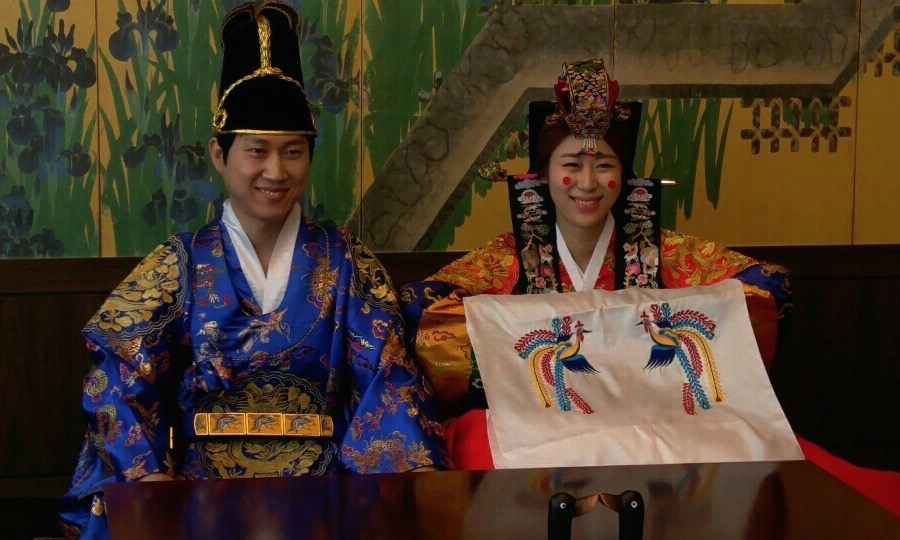 |
| The beautiful bride and groom in their traditional Korean wedding clothes. |
A Word on the MERS Scare
On a more somber note, I and all the other people in Korea were recently introduced to a whole new adventure that no one could have predicted. At the end of May, a 68-year-old Korean man came back from Saudi Arabia, visited several hospitals in Seoul with what seemed to be pneumonia, and then was discovered to have the MERS (Middle East Respiratory Syndrome) coronavirus, which originated from camels in Saudi Arabia in 2012. Henceforth started the MERS paranoia in Korea. Because the man had visited so many hospitals and the government took so long to warn other patients that they may have been infected, the virus has spread more than it really should have. As of this post, the total number of confirmed MERS cases in Korea has risen to 182, the largest outbreak since Saudi Arabia. Of these, only 31 people have died, most of whom were old (over 70) or already had preexisting conditions. Around 2,500 people are still being quarantined, and the South Korean government just passed a new law allowing jail time and/or a large fine to be given to those who lie about being exposed or try to escape quarantine. Sales of masks and sanitizer have shot up around the country, and more than 2,000 schools have shut down, mostly around Seoul.
As for the coronavirus itself, it is thought to spread only through direct contact with someone infected—for example, in a hospital or home setting—and it can take up to two weeks for the virus to start causing symptoms. In the meantime, a person who is infected may proceed with his or her normal life, coming into contact with hundreds of others, until the virus takes its toll. I think this is what scares people the most.
As for the coronavirus itself, it is thought to spread only through direct contact with someone infected—for example, in a hospital or home setting—and it can take up to two weeks for the virus to start causing symptoms. In the meantime, a person who is infected may proceed with his or her normal life, coming into contact with hundreds of others, until the virus takes its toll. I think this is what scares people the most.
Two weeks ago, one of the patients infected in the famous and now notorious Samsung Hospital in Seoul came back to Daegu, and he and his family are currently being treated in a hospital not too far from where I live. I had seen pictures of masked people in Seoul—even a joke picture of an entirely masked wedding—but I wasn’t prepared for it to come to my home city. All of a sudden, everyone was talking about MERS constantly. Every other person on the subway car was wearing a mask. The number of students wearing masks in my class rose to about two-thirds at one point. Another branch of my hagwon in Daegu was shut down because the son of Daegu's first MERS patient was a student there. Parents started calling my hagwon, concerned that there was an exchange of teachers between the two branches and that maybe our school was infected, too. Our boss gave us all cotton masks and recommended we wear them in public places. One of my teacher friends is even required to wear a mask while teaching her class. We’re now ending our classes a few minutes early to make sure all the students wash their hands before they leave, and they’re all required to wash or use sanitizer before they come in. While the scare has generally died down in the last week or so—much fewer people are wearing masks now, the number of MERS patients has mostly stabilized (except for that new hospital in Seoul that just got infected…), and MERS is no longer a part of every conversation—I still had a student ask me last week why I wasn’t wearing a mask and then proceed to offer me one. It’s been hard not to let the paranoia affect me, and I think we’re all looking forward to when this MERS scare goes away for good.
Let me just leave you all with a powerful message about hope from Daiso, the most amazing dollar store I have ever and will ever shop in:

Let me just leave you all with a powerful message about hope from Daiso, the most amazing dollar store I have ever and will ever shop in:
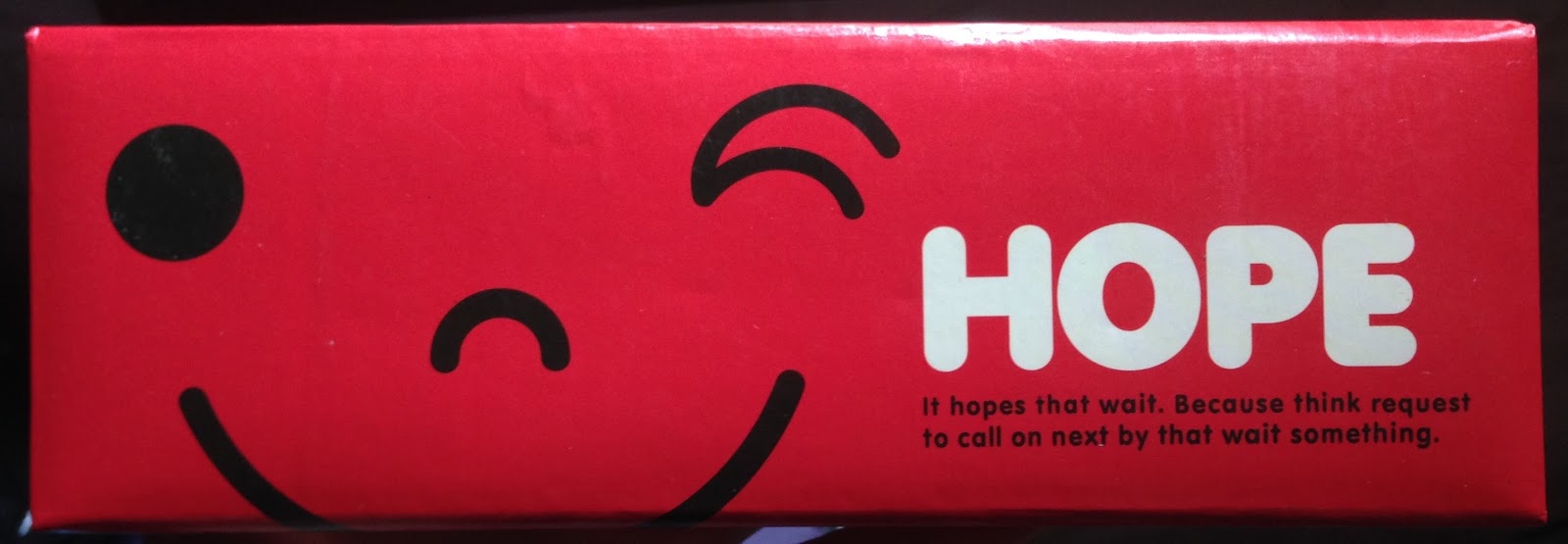
"HOPE: It hopes that wait. Because think request to call on next by that wait something."
If you would like one of these gems for your own, just let me know. Peace ~




.jpg)








.jpg)

.jpg)
