Sunday, April 26, 2015

Jeju Island

Let me start by saying that Korea celebrates two New Years: the traditional one on January 1st (when everyone turns a year older), and the Lunar New Year, or Seolnal (설날), which this year fell on February 19. This second New Year is a huge deal in Asia, which means that even many of us hagwon teachers get a small vacation (three whole days!!) for the occasion. But because almost everyone else in Asia also gets off for Seolnal, that means everyone wants to travel...and ticket prices are through the roof. Since I wasn't willing to pay hundreds more for plane tickets that would normally be reasonable, I decided to stay local and go to the famous Jeju Island, or Jejudo, instead. It’s one of the main tourist destinations for visitors to Korea, as well as for native Koreans.

Note: I went through my favorite travel group, WinK (When in Korea), because I'll admit that having everything planned for me is much more appealing than having to do all the work myself. While it was probably more expensive than if I'd done it alone, I got to see all the best highlights of the island within a short time, never had to worry about transportation, and got to meet and befriend foreigners from all over Korea and the world. I'd recommend the experience to anyone. 

Our ferry to the island
Now, keep in mind that when I said Jeju was local, I didn't mean it was actually close by. It involved traveling for a full 12 hours both ways, first on a subway, then train, then bus, and finally a ferry (yes, like the ferry that sank on the way to Jeju a year ago). The journey wasn’t fun and, unsurprisingly, we were all exhausted after traveling throughout the night. It didn’t help that we arrived to fierce wind and disappointingly gray skies. To be sure, taking a plane would've been loads faster, but it also would've required more money. 

And now, I present my wonder-filled trip to Jeju Island. 

WEDNESDAY

1) The first place we went after arriving on the island was the notorious Loveland (aka Lu-buh-lan-duh), whose true nature I had learned about only the night before. Considering Korea's obsession with cutesy romantic things, I had assumed this place would just involve a lot of hearts and benches and cute coupley picture spots. 

Ha. Ha. 

Apparently the faucets worked, too.


In case you got lost.

Welcome to what should've been called Sexland. Once again I was taken aback by the contrast with Korea's supposedly conservative culture. Wherever you looked there were penises, in statue form or used as arrows pointing you in the right direction. The park was filled with statues of people having sex in different positions, gigantic structures in the shape of genitalia, and even machines where two metal figures went at it when you cranked the handle. It was like the entire place was designed by an immature 16-year-old. There was also a mini museum with different sex toys on display and even a little gift shop. Lovely.
 
        
         "Greek Love"

    
But it's so pretty.
       
      
      Creeper.

 
This bike was "for women
only"…let's see if you can
figure out why.


Korea has the best picture spots.


        I actually really liked this statue.


For the people who were into horseback riding—apparently there's a special breed of Jeju horses—they did that first and then joined us at Loveland. But for the people like me who were there the entire time, two hours in dreary weather was far too long to spend staring at naked parts.


2) After Loveland we were all taken to our motel, where we could finally rest and wash up. That night we had a group dinner at another staple of Jeju: a black pig restaurant. I'm not sure how black pig barbecue is different from normal pig barbecue (I happily sat at the tofu table), but the others said it was quite good. 

THURSDAY

1) Thursday was packed full of events. First we went to Olle Trail #7 on Jeju's southern coast. It’s part of a series of 12 long walking paths bordering the island, which are said to be based on the Pilgrim’s Trail in Spain. They’re famous for their beauty, and they allow tourists to explore the scenic forests, villages, and coasts of Jeju on foot. Unfortunately we were able to spend very little time walking along the path, though the views of the ocean and the rocks were still astounding. This was one of the stops I wished we could’ve spent more time on, but such is the nature of a guided trip.


The water was sooo pretty.

The famous Oedolgae Rock


2) Our second stop was the Daepo Jusangjeolli Cliff, popularly referred to as the "Superman Rocks" because of its apparent resemblance to kryptonite. They're the result of lava flows cooling and hardening into five- or six-sided columns as far back as 250,000 years ago. They were really quite a sight.  


3) Next was Sanbangsan Mountain, which is made entirely of lava from a violent eruption hundreds of thousands of years ago. There are a couple of temples on the mountain, and near the top is a small grotto where people can pray to Buddha and leave some small offerings. In this cave is also a basin of water filled by a slow, consistent drip from the rocky ceiling above. Legend has it that if you drink three scoops of this water, you will gain eternal life. But be warned: If you drink two or four scoops, you will die immediately. (Don't worry, I drank exactly three.)

The basin of eternal life or
instant death

The grotto at the top


The beautiful view from one of the
mountain's temples

-------------------------------------------------------------------------------------------------------
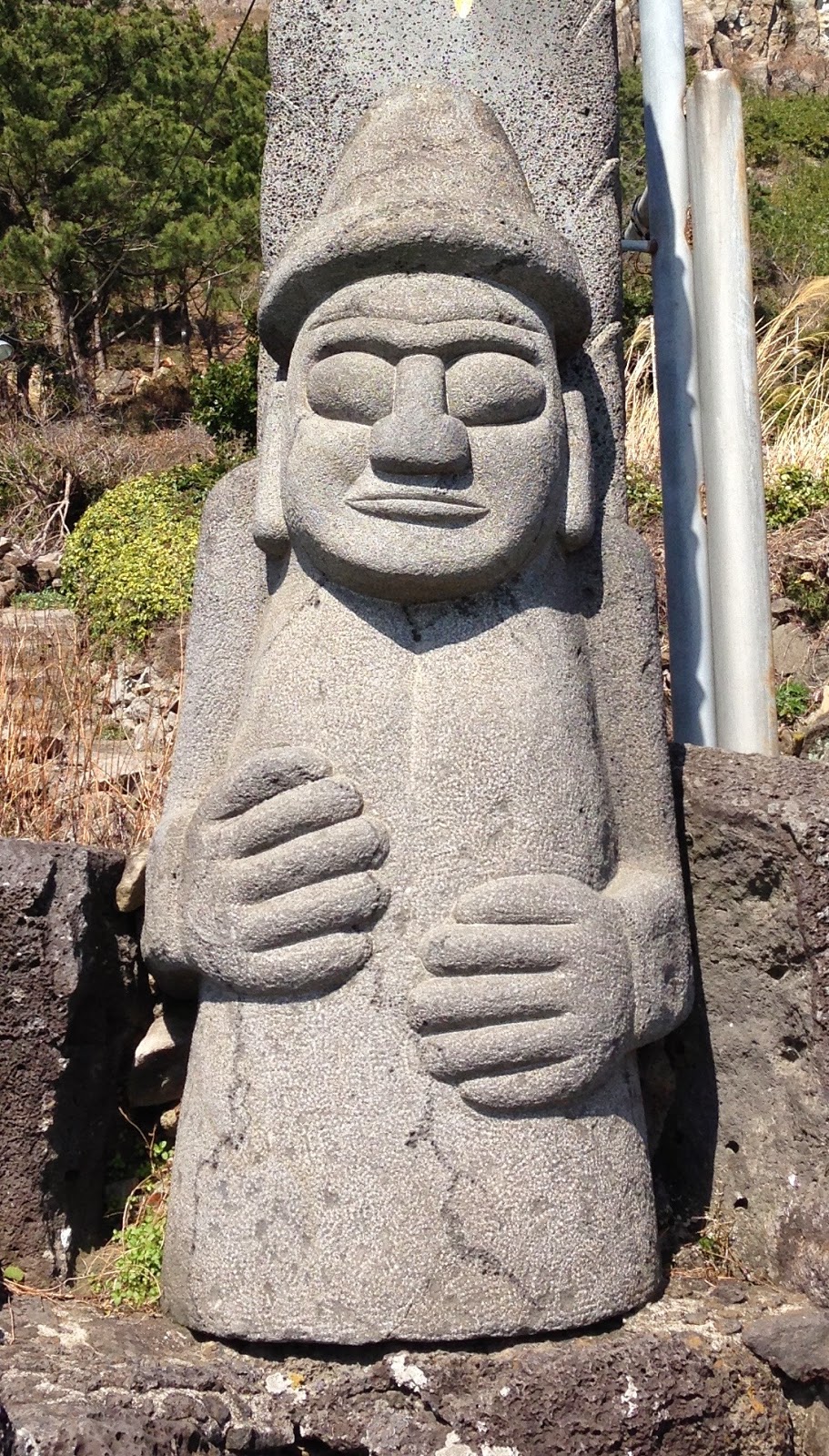
Spot the Dolhareubang!


*A quick note on Jeju's official mascot, the Dolhareubang, or "Stone Grandfather." This stone statue can be seen all over the island and in all different sizes. While not the most attractive sculpture, it's instantly recognizable and has become the international symbol of Jeju. I even have my own mini statue and a keychain of it. :)


    ---------------------------------------------------------------------------------------------------------


How cool is that?


An epic jumping shot


4) Across from Sanbangsan Mountain were the Dragon Head Cliffs (part of Yongmeori Beach), a series of rocks along the coast with a very unique color and formation. They were all clearly striated and had many strange pockets that made them fun to explore.


5) The day tour on Thursday was rather rushed, so we hardly got to spend any time at Jeju's famous Cheonjiyeon Falls. We saw only one of several waterfalls, and then turned around and went quickly on to the next site. Still, despite it being winter, the waterfall was beautiful and made a great spot for pictures.


6) Our next stop was Jungmun Beach, one of the many scenic beaches of Jeju. Some daring members of our group insisted on proving their manliness and ran into the freezing water for a minute or two, but the rest of us just enjoyed the view and the feeling of sand on our feet. The sand itself was a pretty but unusually dark mixture of crushed-up shells.


We all got plenty of vitamin C that week.
7) One of the events I most looked forward to was our trip to an all-you-can-pick orange orchard. Jeju is famous around Korea for its oranges, tangerines, and hallabongs, a special type of puckered-looking orange originating in Japan. In supermarkets around the country, orange juice from Jeju is sold as its own special product. And chocolates from Jeju flavored with hallabong or other fruits make for popular gifts from those visiting the island.
Hallabong oranges

When we got to the orchard, each pair of people was given a small basket, some gloves, and pliers, and we were let loose for half an hour to pick away. Quite a few of the oranges (really just tangerines) were already rotten, but we all stocked up on enough good ones to be satisfied. And they really were deliciously juicy and sweet. 


FRIDAY


1) We started our Friday tour off with a morning visit to Crater Mountain Sunrise Peak, or Seongsan Ilchulbong, on the eastern coast. Named one of UNESCO's World Heritage sites, this mountain was also formed by volcanic activity 100,000 years ago. What makes it distinctive are the strange-shaped rocks and the giant crater at the top, which is supposed to look like a crown. Like many "hikes" in Korea, the path upwards was essentially a long wood-and-stone staircase. I was surprised by all the Chinese tour buses we saw there; it must be a popular destination for Asian tourists.

You can kind of see how it
resembles a crown.

The view from halfway up


From a distance


2) My favorite part of the trip was definitely our afternoon spent on Udo, or Cow Island (supposedly it looks like a cow lying on its side). We were told before we got off the bus to look for the legendary Udo divers, older women who dive down to great depths in the sea with no scuba gear in search of things to sell on the market: octopi, sea urchins, abalone, etc. In recent years they have been so successful that they've made enough money to send their daughters to universities on the mainland. As a consequence, these "sea women" are dying out, as is their tradition. Unfortunately I didn't get to see any on my visit.

After a 30-minute ferry ride northeast of Jeju to the much smaller Udo, during which seagulls swarmed our ship like flies (tourists = food, obviously), we arrived to perfect weather. Whereas the rest of the trip was generally very structured, we were free to explore the island for a full 4 hours, which honestly wasn’t nearly enough. 

It's meee. :)
Udo was essentially a lawless playground for tourists. Anyone with an international or American license was able to rent a scooter, ATV, or weird 3-wheeled buggy-thing, whether he or she had any practice actually driving one of these things or not. (If you didn't have a license, you could rent a regular or electric bike.) I’ll admit that the most experience I’d had was riding on the back of a motorcycle once in college, but I decided to take the risk anyway and rent a scooter. I’m not going to lie: it was terrifying at first and it took me some time to get my balance, especially every time I had to stop and start again. But the feeling once I got going was wonderful. It was an ideal way to tour the island and enjoy the gorgeous views—of course, while watching out for similarly inexperienced drivers.


I mean look at how blue that is.
I haven't even messed with the colors.
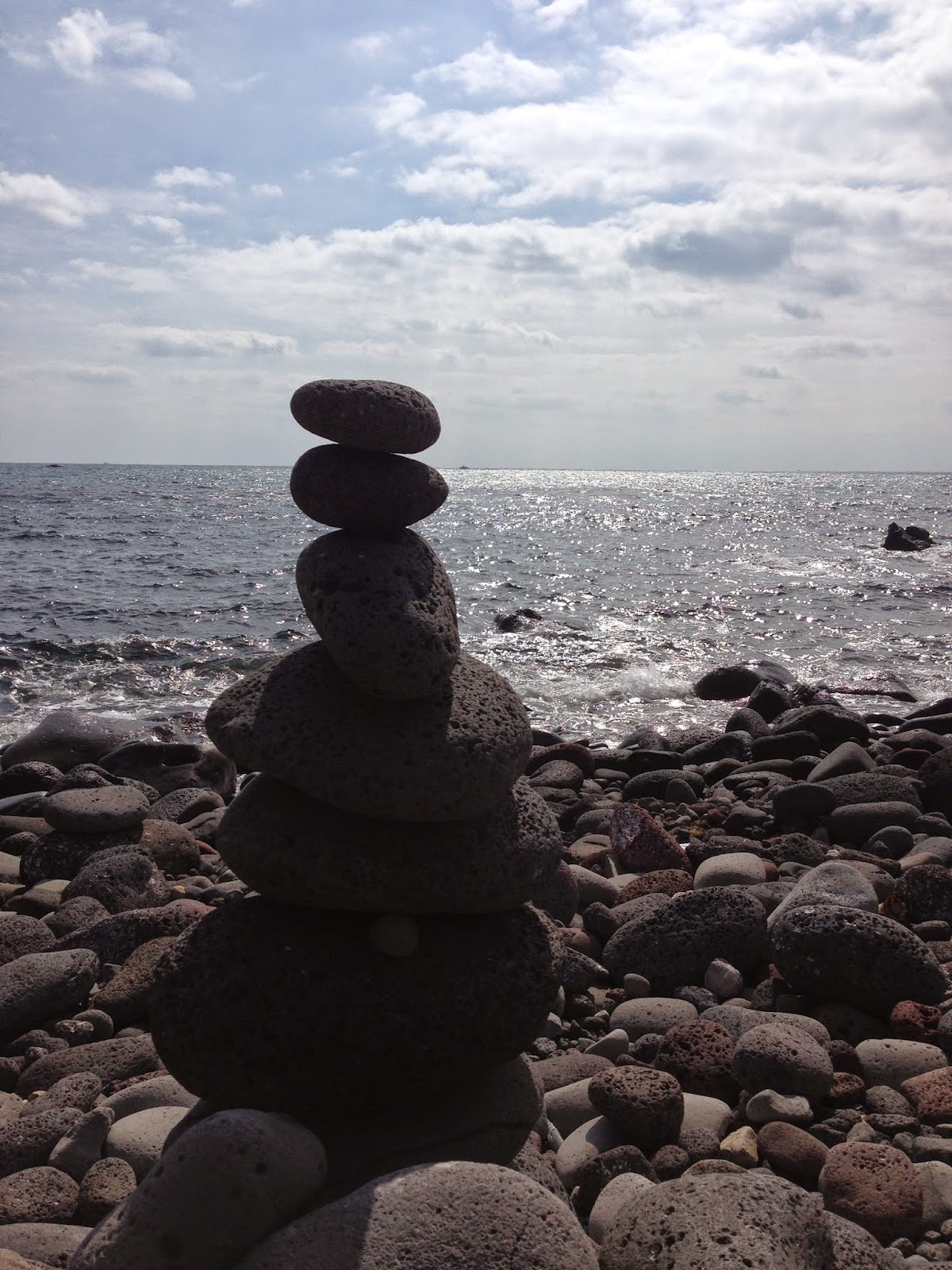
Although the island was quite small, Udo had many wonders worth exploring. There were two main beaches, the coral beach and the black sand beach, whose sand is supposed to be therapeutic for the feet. Somehow I didn't make it to either, but the smaller beaches were beautiful and were filled with rounded, porous volcanic rocks of all sizes and colors—the same kind that are sold as foot scrubbers in stores. These rocks were often set up in little man-made stacks around the island, which I've seen quite a few times around Korea in general. As for the water itself, it was ridiculously blue—so blue that I was convinced the color was somehow photoshopped as I was staring it. I don't think I've ever seen water that blue before.

It may not have been
hot, but at least it had a
delicious peanut sauce.
Why Marilyn Monroe? Who knows.
After exploring the island for a while, we stopped at the small but renowned Marilyn Monroe restaurant, which served monster burgers and was decorated all over with pictures of the famous actress. And of course there was also Udo’s famous peanut ice cream and peanut makgeoli, or rice wine.


Overall our trip to Udo made for an awesome afternoon, and I’d go back in a heartbeat.
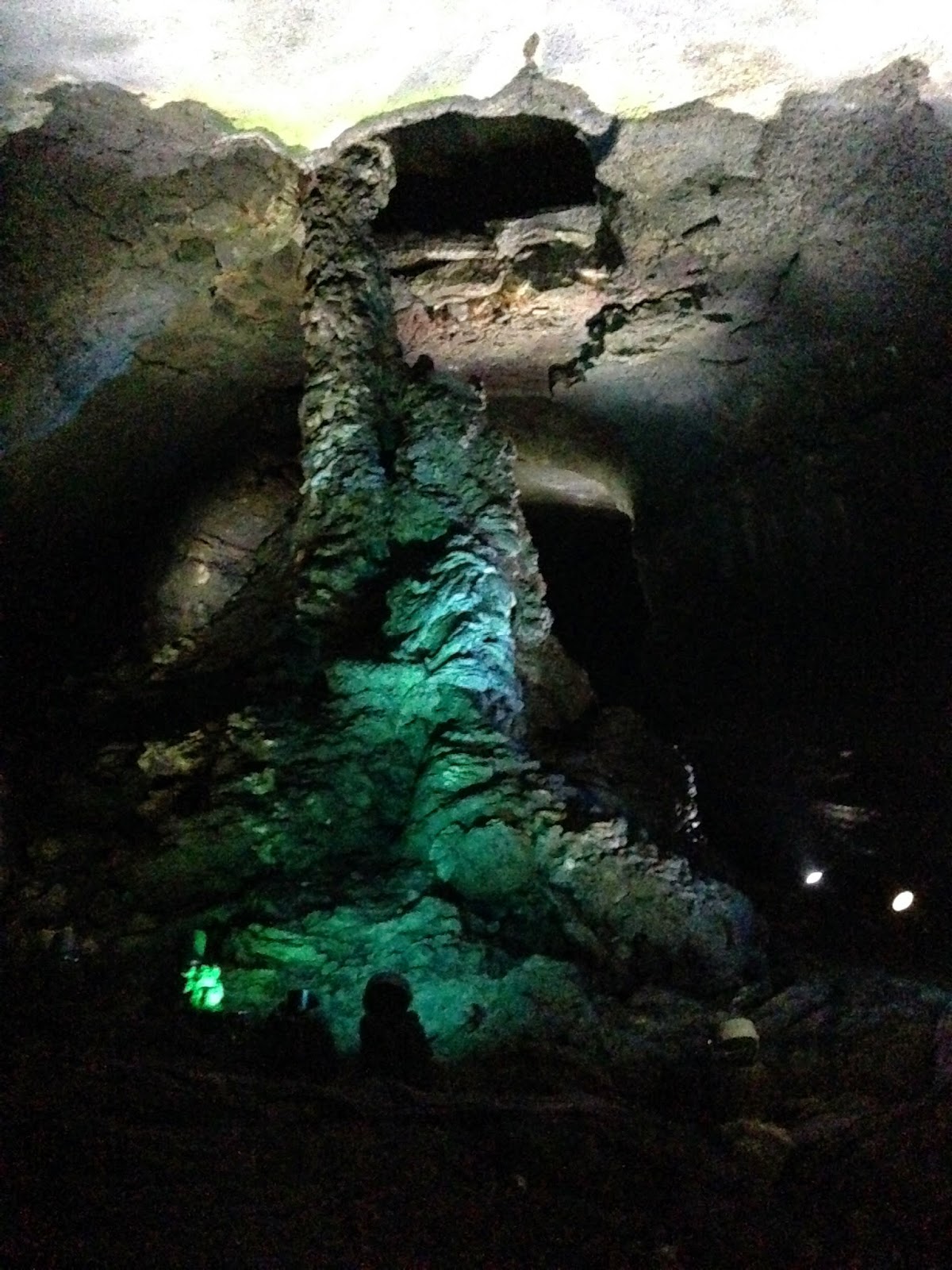


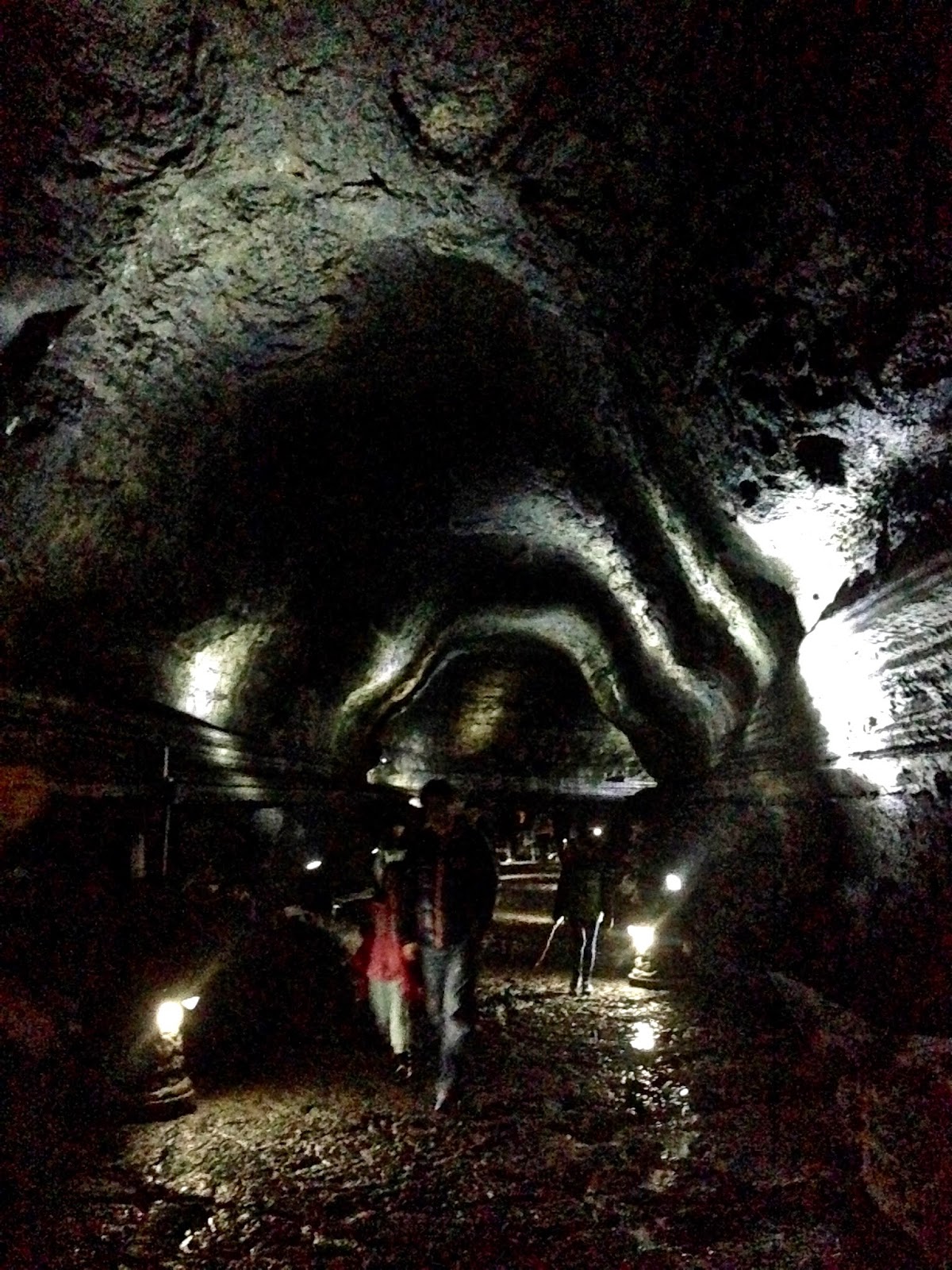
3) Our Udo adventures were followed with a visit to the huge Manjangul Lava Tubes. I can't say I had even heard of a lava tube before. Because of how the lava formed and hardened over the years, it created a distinctly layered and quite long (4.6 miles total) lava cavern up to 60 feet wide and 75 feet high. It contains examples of multiple different lava formations, which various signs made sure to point out along the way. Descending the stairs into the tube felt like going down into the Underworld. It wasn't well lit and there was water in small pools on the ground, so we had to be very careful where we stepped. Still, it was interesting to see as a one-time thing. At the end of the tunnel was a giant "lava column" formed by lava pouring down from the ceiling. It's happens to be the largest lava column in the world, measuring at 25 feet high.


Ouch.
4) The last stop of the day was the Maze Park, my very first hedge maze. I know hedge mazes aren't particular to Jeju or Korea, but it was an experience nevertheless. Any attempt to use strategy quickly failed, and eventually our trip leader helped us out because he was too impatient to wait for all the newbies.


SATURDAY

1) On the last full day of the trip, we had the option to hike Mt. Halla (Hallasan), the tallest mountain in Korea. Although I had initially signed up for the hike, in the end I decided not to go because A) it was scheduled to rain all day, and rain + mountains = my worst nightmare (I slip enough on loose rocks as it is); B) it was cold, and being cold and wet sounds miserable; and C) the hiking group was leaving at 7:30am. I was impressed that some people did go regardless, though they admitted later that they were extremely ill-prepared for the constant downpour and the sheer amount of snow on the mountain. They weren’t even allowed to hike up after a certain point because the conditions were so dangerous. Many of them said they ended up sitting on their bums and sliding down most of the way back because it was so wet and the snow was so deep. It was probably for the best that I didn’t go, but it sure would’ve made for a good story.

Even from this distance you could see all the snow on the top. 


2) While the braver/crazier members of our group were off getting soaked on a freezing mountain, I got to spend some time walking around Hamdeok Beach, where our motel was situated. Although the weather wasn't ideal, and I'd like to go back in the summer when the water is warm enough to (sanely) swim in, the beach was scenic nevertheless. Since Jeju is a volcanic island, many of the rocks had a unique black, porous surface that was quite beautiful, and the beach was extra pretty at sunset.


And there you go: My eventful, picture-filled 5-day trip to Jeju. (I guess 4 days if you include the travel.) It's definitely a place worth visiting if you ever come to Korea or if you're already here. So go on, get to it!


Sunday, March 1, 2015

Korea in a (Big) Nutshell

Now that I've been in South Korea for 6 months, I’ve learned and observed some interesting things about Korean culture that I think are worth sharing. 

First, some basic differences between Korea and the U.S. that I should've mentioned a long time ago:

Such a handsome fellow.

-1000₩ (won) is about the equivalent of 1 USD, though technically it's 91¢ now. It makes conversions easy—just chop off 3 zeroes to get to U.S. dollars.

-Korea is 14 hours ahead of the Eastern time zone, which means 5pm here is 3am in New York. When Daylight Savings starts again, it’ll go back to being 13 hours ahead.

-Koreans calculate age differently than Westerners. First, they consider newborns to be 1 year old to account for their time in the womb. Second, they use people's birth years instead of their birth days. Accordingly, everybody turns a year older on New Year's Day. For example, if you were born in June of 1990, your Western age would be 24, but your Korean age would be 26. I can’t say I’m a fan of this system. 

-I was warned from the very beginning not to drink the tap water here because it contains hard metals that will eventually build up in your system. So that's comforting. 


And now, in no particular order:

1) Koreans are NOT short. What a misconception on my part. Ha. Apparently they have the tallest average height of any Asian nationality.


Beachside "camping"
You can find hiking gear stores in
any market.
2) Koreans love to go camping—and by camping I mean setting up one's tent in a park, bringing tons of food along or ordering takeout, and going home at the end of the day. But what they love even more than camping is hiking, or, more specifically, hiking gear. You can see middle-aged or old people decked out in full hiking outfits at any time of the day, whether they just came back from a group hike or they're making a trip to the grocery store. It's as ubiquitous as the American t-shirt and jeans. 

3) Unfortunately there are no laws against too much noise in Korea, which means being woken up in the morning by a truck blaring advertisements for fresh fruit is relatively normal.

4) Every now and then I’ll see a sign whose title is in English…and then everything else is in Korean. Please tell me how a sign whose only English word is “Information” is going to help me.

5) Koreans really like Maroon 5….random.

6) Many buildings and apartments use a type of heating called ondol (온돌) heating. You press a button on your thermostat and it turns on a big machine that heats the water running through pipes under your floor. Then, since heat rises, eventually your whole room becomes warm. It tends to be expensive and can take quite a while before it's really effective, but at least it makes the floor nice and toasty for your bare feet. :)
This looks like a Kit Kat,
you say? Nonsense.

Of course this has nothing
to do with Monopoly.
7) Korea seems to have no copyright laws, at least when it comes to copying Western brands. I've seen small stores use well-known logos from companies like Apple and Burger King to falsely encourage name-brand recognition. The popular Korean cosmetic store Nature Republic uses the exact same typeface as Banana Republic in the States. And while you can see many Koreans with North Face clothes and gear, there are also the equally popular brands North Cape and The Redface. What a conveniently familiar choice of words! 

8) There is a strange fascination with watching toddlers play/eat/throw tantrums on TV—even at the bank. Koreans also love to insert cutesy speech bubbles and cartoony sound effects into reality TV shows. And I find it interesting how, despite the prevalence of smoking here, the cigarettes in shows like "The Simpsons" are blocked out.

9) THERE IS SO MUCH SPITTING. Old men, young men, young women, dainty old ladies. Anywhere you go you can hear someone hacking up a huge wad of spit and letting it splat very loudly onto the sidewalk. Some people will even spit indoors. It's gross and it makes me cringe every time. 

10) Koreans are known for having really nice skin. Many of them use skincare programs that involve 8-10 steps; I don't even try to keep up. Accordingly, you can find brightly lit cosmetic stores everywhere you go. Sometimes you'll even see three or four different stores lined up right next to each other.

11) One thing I've grown to appreciate is that people here aren't too self-conscious to protect their faces against the cold. You can see people of all ages wearing cotton face masks in winter because they don't want to breathe in the cold air. That makes so much sense! I propose we adopt this in the U.S….you start.

12) I had read on multiple sites before I left that bedsheets and full-sized towels would be extremely difficult to find. While not impossible to find sheets, each piece of a sheet set is sold separately and is very expensive, so I've learned to live without them. As for towels, for some reason, Koreans use the equivalent of a hand towel for their bath towels, too. It doesn't make sense. But I was able to find a beach towel pretty easily to do to the job. 

Definitely a legitimate parking spot.

Stylish.
13) I'd also read that the driving in Korea was quite bad, but I've seen much worse in other countries. However, there are no rules when it comes to parking, whether that's on the street, on the sidewalks, in the middle of crosswalks, or in incredibly tight spots that make it hard for even pedestrians to squeeze by. One interesting thing I noticed is that half of the cars I see have little styrofoam pads on their doors to prevent them from accidentally denting other cars. They're pretty nifty. 

Practicality at its best.

14) Biking is really popular here, both as a method of transportation and for exercise. You can also find many bikes with small wheels and high seats that fold in half for easy transport (see picture). As I mentioned before, the bike lanes in cities are usually part of the sidewalks. Unfortunately, that means people on scooters and motorcycles (the main method of food delivery) also see it as their right to ride on the sidewalks, so pedestrians had better jump the heck out of the way.


15) Public transportation is great, cheap, and extremely reliable. Taxis are much cheaper than in the U.S. The subway (in Daegu, at least) is about $1 each way regardless of distance, and both the subways and the subway stations are very clean. Some cities even have heated subway seats in winter. If you want to get to another city quickly, there’s the expensive but very fast KTX train. If you prefer a cheaper option, the inter-city buses here are incredibly prompt. If the bus to Seoul is scheduled to leave at 6:30, it leaves at exactly 6:30. The only thing to beware of is the intra-city buses. As soon as you board, you'd better grab something quick, because that bus driver is jamming on the gas the moment the last person's foot is in the door. Multiple times I've seen people—including the elderly—half-fall onto other passengers because they didn't grab onto a pole or seat in time. The jerkiness of these buses tests both your balance and your strength—in other words, how well you can hang on for dear life. 

These warnings are everywhere,
just in case you forget.
It's watching you.
16) Korea is known for being an extremely safe country. I've often heard that bike theft is the most common crime. For example, this study was done to show just how trustworthy Koreans are. Knowing this has allowed me to take less precautions than I probably should. Then again, I've also left a bag with my jacket, iPod, and phone charger on a city bus, and I got it back from the Lost & Found with nothing missing. While I've been told that the police force doesn't have much power (you sometimes see groups of neon-clad police officers strolling casually around), there's this thing called CCTV that is constantly watching you. There are cameras on every main street and sidewalk, and in every park, playground, store, and classroom. Some of these cameras even have ominous red lights. Big Brother, anyone?

17) I also recently learned that there are absolutely no sort of self-defense laws in Korea. If someone punches you and you punch him back, you're both getting arrested for assault. If someone breaks into your house and you stab him, YOU'RE serving a full sentence in jail. Your best bet? Scream and run away. 


Mmm…….no.
18) The bathrooms here were somewhat of a shock when I first came to Korea. The majority of stalls have normal toilets, but some still have traditional holes in the floor. (No thanks.) Also, in most public restrooms, the toilet paper dispenser is outside the stalls, so you have to stock up before you go in. And in some bathrooms, there's no toilet paper at all. In subway bathrooms, you sometimes have to BUY your toilet paper from a machine first. Other bathrooms don't have soap, or have this weird soap-on-a-stick contraption. And all bathrooms are weirdly insistent on not throwing tissue away in the toilet. I've also really learned to appreciate hot water. Since hot water must be manually turned on from a central source (which costs extra money), most sink water in winter feels about two degrees away from coming out as pure ice.

19) Another annoying thing is that public trashcans are so rare. This is because the government wants people to take their trash home and recycle it/pay for their own trash bags. The unfortunate side effect is that there is trash everywhere, even on nice streets or in beautiful places like temples. It's an eyesore, and it's often old people who can’t afford to retire who go around picking it up.

20) Speaking of the elderly, there’s no sort of retirement system here—if your kids don’t take care of you, you’re screwed. You’ll often see older men (ajishis) and women (ajumas) hunting through trash like hawks and picking out all the cardboard, which they then strap in enormous piles to their bikes or carts and lug to the nearest recycling plant in exchange for a very small sum of money. I suppose it’s an efficient way to encourage recycling, but it’s also kind of sad to see people old enough to be grandparents scavenging to get by.


An ajuma parks this cart in my
apartment building every night.
I don't know how the hunched, wrinkled
little ajuma in my neighborhood
manages to haul so much stuff around.
This is pretty normal.


You can only access this workout area
after a small hike up a mountain.


21) Other than that, old people in Korea seem to have a pretty healthy lifestyle. They're the main demographic by far in any given park and on most mountain trails. You can also seem them using the public “exercise” machines scattered about in parks/ playgrounds/halfway up mountains/in the middle of nowhere. Many of these machines are fun to play around with but have dubious practical use.


The very popular leg-swinger.
Get too excited and you might
just pop a hip out of place.
Randomly placed on the side of
a bike path.

Somehow spinning this wheel is
supposed to stretch you out…?


Makgeolli
It doesn't actually say "soju"
anywhere on the bottle, but
everybody knows what it is.
22) Koreans are known for their love of drinking—and their most popular drink is the notorious (and extremely cheap) soju. There’s also makgeolli, a famous and inexpensive rice wine. In convenience stores, these drinks can be even cheaper than water. On any night of the week you can see businessmen stumbling around drunk as early as 10pm. You could call it "efficient drinking": they know they have to go to work the next day, so they don't mess around with the business of getting drunk. That also means there's a lot of vomit around. Many bars downtown will stay open all night, which means a night out often ends at 6 or 7am.


23) South Korea is also known for having by far the highest rate of plastic surgery in the world. Many Koreans have the unfortunate idea that, in a situation where everyone has similar qualifications, looks are the only way to come out on top. One result is the ever-popular double-eyelid surgery to make one's eyes bigger and more Western-looking, often given to girls as a middle or high school graduation present. But one can also get total facial reconfiguration—including getting one’s jawbone shaven or chiseled down. Some people even get restalyne filler injections: little gel particles injected under their eyes to make their lower eyelids puff up. (Somehow it’s supposed to make them look younger because it’s what kids have naturally.) The ideal Korean face has an oval shape, pointed jaw, narrow nose, and big eyes—and I guarantee that you can see this in 9 out of 10 K-pop stars. Therefore it shouldn’t be surprising just how many ads for plastic surgery and implants you can find in the subways. Getting plastic surgery here is relatively cheap, so that people from other Asian countries often come to Korea for this reason. Unfortunately, aiming for one ideal face can lead to lots of people looking very similar. There was some controversy last year over these beauty pageant contestants. If you look through their pictures quickly, it looks like they’re all one person who simply has many different hairstyles and outfits. But nope, they’re all separate women.

From Cinderella Plastic Surgery in Seoul (in the same building as a movie theater):

That's not beautiful; it's creepy.

How are these the same person?!

24) On a lighter note, I love reading Korean transliterations of English words. Christmas, which has two syllables in English, becomes five syllables in Korean: Kuh-ree-sa-muh-suh (크리스마스). There is also a tendency for English-learners to add “-uh” to the end of words and stretch out short “i” sounds, so “this” becomes “this-uh” and “it” becomes “eat.” Furthermore, Korean students have a particularly hard time with their “r”s and “l”s, since the Korean equivalent is a weird in-between letter (ㄹ)—so “rock” sounds like “lock” and one student spelled “looking" as “rooking.” And there's no “v,” “z” or “f” in Korean. That means “Fighting!”, a popular word of encouragement for Koreans, sounds more like “Pie-ting!” It’s also led to some confusion when my students insisted they went to the Jew last weekend…when really they meant the zoo. Oops.


And there you have it: my foreigner impression of Korea. I’m aware that I would probably have a very different perspective if I understood more of the language, but it’s the best I can do for now. Let me know below what you thought was the most interesting or surprising!